"Knowledge speaks, but wisdom listens." - Jimi Hendrix

"Obstacles are those scary things you see when you take your eyes off the goal." - Henry Ford
Showing posts with label AP US Homework. Show all posts

Tuesday, February 1, 2011

Bellowing Herds of Bison and the End of the Trail


Buffalo were a main component in the lives of Native Americans. They were used for food, their dung for fuel, and their hide for clothing, lariats, and harnesses. After the Civil War, over 15 million still roamed the plains. With the building of the railroads, their numbers soon declined as they were hunted by workers for hides, select cuts of meat, or just for sport (many were killed by rednecks hunting from the train.) By 1885, only a thousand or so buffalo were still alive.


General awareness to the plight of the Native Americans grew in the 1880's. Helen Hunt wrote two books - A Century of Dishonor and Ramona on the treatment of Native Americans that raised awareness and were widely read. Christian reformers sought to bring Christianize the Native Americans but sometimes resorted to extreme measures.
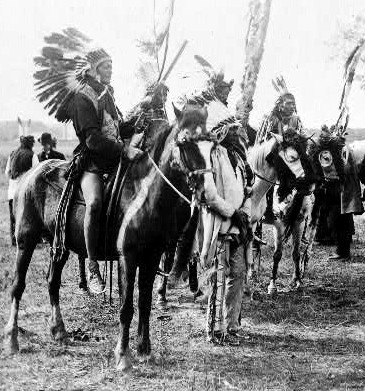


A hard line was taken towards the Native americans when their Sacred Sun Dance was forbidden. When the Ghost Dance cult spread to the Sioux in 1890, the army stamped it out at the Battle of Wounded Knee where 200 Native americans and 29 soldiers were killed.


The Dawes Act of 1887 dissolved many tribes as legal entities, got rid of tribal ownership of land, and set up individual Indian family heads with 160 acres of land. It also promised them citizenship in 25 years if they behaved well. Proceeds gained from the selling of the land taken from the Native Americans was used to educate and civilize the native people. This act showed the hard line taken by the government towards Native americans until 1934 with the Indian Reorganization Act that restored the tribal basis of native life.

Tuesday, September 28, 2010

Foreign Aid From France And Friends


French aid, began in 1778 with a treaty came in the form of GUNS and other much needed supplies. These supplies proved vital in the American push to extend the war. French troops joined the war in 1778 in an attack on Newport, Rhode Island.


The Spanish joined in 1779 over a dispute with Britain over the Gibraltar. The Dutch joined following a dispute over terms of neutrality with the British.


The Spanish contributed mainly in the form of their powerful navy. They helped by causing the British to divert troops to other locations such as Gibraltar where they sieged it for 4 years though unsuccessfully. Spain also contributed gold and silver.


The Dutch also contributed in the form of their navy. Their contibutions were mainly in India. They, along with the French fought the British because all three had outposts there. The Dutch also contributed goods and money.


In 1780 the Armed Neutrality was formed by Catherine the Great, it included Denmark-Norway, Sweden, the Holy Roman Empire, Prussia, Portugal, and the Two Siciles.


In 1781, Admiral De Grasse and Rochambeau of the French helped defeat the British at the Battle of Yorktown. This was the most important French contribution.


Both France and Spain received territorial gains when America won its independence.
France gained Tobago, Saint Lucia, the Senegal River area, and fishing rights in Terra Nova. Spain gained Minorca and Florida.

Overall, the French made the biggest contributions to the Americans lending them money, men, and supplies. They also contributed ships and helped the Americans build up their meager navy. They made telling contributions on all fronts of the war. The Spanish helped with their navy and movey and contributed in the South and in Minorca. The Dutch contributed their navy, goods, and money and fought the British in India. Contributions by the Spanish and the Dutch have sadly been overlooked. The Spanish played a pretty crucial role in our independence. As is common, British stupidity is evident here. They forced both the Spanish and the Dutch to join up with the French in the cause of American Independence.

Tuesday, August 31, 2010

AP Essay Prompt

The Great Awakening was a religious movement that occurred in the 1730s and 1740s. It began following a time of lows in religious conversions, a lack of religious fervor, and was spurred on by the challenges presented by liberal ideas to the old-religions. It was characterized by the thundering, emotion evoking homilies of Jonathan Edwards, the orator George Whitefield, and the growth of emotion in religion. The Great Awakening, occurring in the 1730s and 40s, was a time of rebirth and renewed fervor for religion in the colonies. It was ultimately successful, bringing an awakening for religion in America and began to bring about the seperation of church and state.

The Great Awakening was period of renewed vigor and fervor for religion in the colonies. Preachers like Whitefield and Edwards brought emotion into religion and a change from the "dead dogs" - though in different ways and the idea of emotion in religion became a problem. Schisms occurred with many small churches popping up and competition between American churches grew. As a result of the the new wave of fervor and emotion new waves of missionaries were sent out to both Indians and black slaves. Colleges like Dartmouth and Rutgers were established too. It also represented a monstrous movement of the masses in America, foreshadowing the Revolutionary War.

The Great Awakening also encouraged and moved America closer to the seperation of the church and state. The schisms among the churches that occurred, creating more churches and more denominations made it harder to have a church of the colony. There were so many denominations that it was difficult for the government to enforce the religion as was previously intended. Also, colonies based on a religion and for people of a certain religion were diversified. The governments of theses colonies could no longer uphold and enforce their religion, there were more people of differing denominations.

Tuesday, August 10, 2010

We Are America


This picture tells a lot about America. America is an advanced country as shown in the picture with the train and the industrial center. Also like the picture we are beautiful and unique. Since the beginning, America has been special with its different and experimental views of religious toleration and our political system. The train and the industrial center also represent that we are hardworking. All of these have foundations in our modest beginnings during the times of the first settlers like the Pilgrims. America since the beginning, has comprised hard working people, has been unique/special, and has been America the Beautiful.